Total Kjeldahl Nitrogen in Wastewater
TKN = organic nitrogen + ammonia nitrogen
It is NOT total nitrogen. It does NOT include nitrate or nitrite.
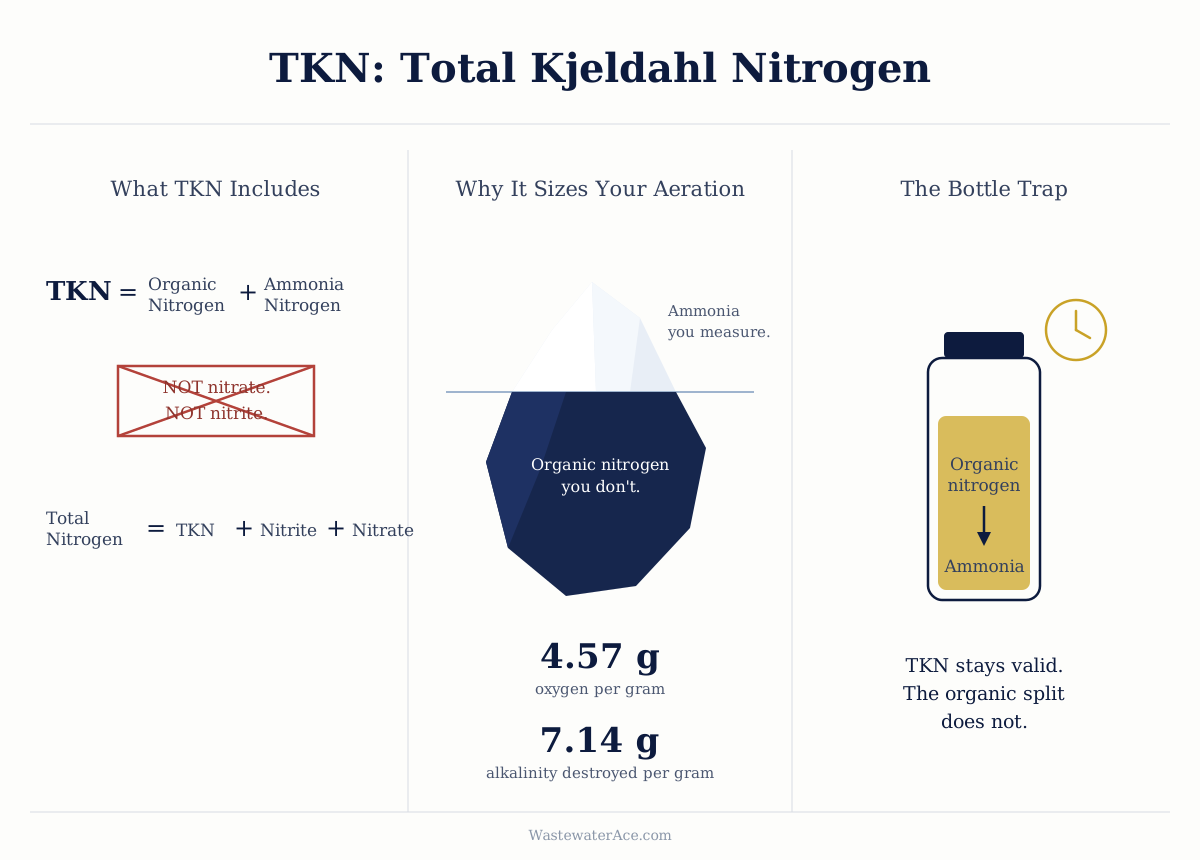
The Nitrogen Balance
EPA Method 351.3 puts it formally: total Kjeldahl nitrogen is the sum of free-ammonia and organic nitrogen compounds which are converted to ammonium sulfate under the conditions of digestion described.
| Parameter | What it is |
|---|---|
| Ammonia nitrogen (NH₃-N) | Nitrogen occurring in the ammonium ion — the first inorganic nitrogen species produced during biological treatment |
| Organic nitrogen | Nitrogen bound in organic compounds — amino acids, proteins, peptides, urea |
| TKN | Ammonia nitrogen PLUS organic nitrogen |
| Organic Kjeldahl nitrogen | TKN minus free ammonia — calculated by difference, or determined directly by removing ammonia before digestion |
| Nitrite (NO₂-N) and nitrate (NO₃-N) | Oxidised species. Not captured by the Kjeldahl procedure. |
| Total nitrogen (TN) | TKN plus nitrite plus nitrate |
Org N = TKN − NH₃-N
TN = TKN + NO₂-N + NO₃-N
TKN gets reported and discussed as though it were total nitrogen. In a raw influent that barely matters — there's little nitrate or nitrite present, so TKN and TN are close.
In a nitrified effluent the distinction is everything. A plant with excellent nitrification has converted nearly all its TKN to nitrate. Effluent TKN reads low, TN reads high, and reporting TKN against a TN limit badly misrepresents the discharge.
If your permit carries a total nitrogen limit, you need TKN AND nitrate AND nitrite.
The TKN calculator does this live — enter TKN and ammonia and it returns the organic split, total nitrogen, and the oxygen and alkalinity your nitrifiers will demand.
Part 1 — Why TKN Is the Number That Matters
TKN is the nitrification load. Everything downstream of it — oxygen demand, alkalinity consumption, aeration basin sizing, blower capacity — follows.
The chain:
- Organic nitrogen in the influent undergoes microbial conversion to ammonia and ammonium
- That ammonium adds to the ammonia already present. Together, that is your TKN.
- Nitrifiers oxidise ammonium to nitrite, then nitrate — Nitrosomonas does the first step, Nitrobacter the second
- Every gram of ammonia-nitrogen consumes 4.57 g of oxygen and destroys 7.14 g of alkalinity as CaCO₃
- So influent TKN, not influent ammonia alone, determines your true aeration and alkalinity demand — because the organic fraction will become ammonia inside your process
A plant that monitors influent ammonia but not TKN is measuring only part of the nitrogen it will have to oxidise. The organic fraction hydrolyses to ammonia inside the plant — it arrives as protein and leaves the primary clarifier as ammonia demand you didn't count.
On a strong-waste day — heavy septage receipt, an industrial protein load, high solids — the gap between influent ammonia and influent TKN is exactly the surprise that shows up as an ammonia excursion two days later.
Typical concentrations
| Stream | Reported TKN | Source |
|---|---|---|
| Typical domestic wastewater | 20–85 mg/L as N | Pennsylvania DEP operator certification training |
| Influent municipal wastewater | 35–60 mg/L | Water Online / instrument application note |
| Well-nitrified effluent | Low — one research system reported 0.26–0.37 mg/L at 98% TKN removal | Peer-reviewed nitrification study |
| Digester supernatant / sidestream | Can be extremely high — one study reported 600 mg TKN/L at a COD/N ratio of 2.2 | Aerobic granular sludge research |
PA DEP gives 20–85 mg/L for "typical domestic wastewater." Water Online gives 35–60 mg/L for "influent municipal wastewater." Not contradictory so much as differently scoped — the wider range covers weak and strong systems, the narrower one describes the middle of the distribution.
Neither substitutes for your own plant's characterisation. Run your own influent TKN across seasons before sizing anything on a published range.
The sidestream problem
Note that 600 mg/L figure. Digester supernatant, dewatering filtrate and centrate carry enormous TKN concentrations at low flow. Returned to the head of the plant without accounting, that stream can be a substantial fraction of total nitrogen load while contributing almost nothing to hydraulic load — and it arrives with a low COD to nitrogen ratio, meaning no carbon to denitrify it with.
Part 2 — How the Test Works
The method is over a century old and the chemistry hasn't changed. Convert every form of nitrogen the digestion can reach into ammonium, then measure the ammonium.
| Stage | What happens |
|---|---|
| Digestion | Sample heated with concentrated sulfuric acid plus a catalyst — traditionally potassium sulfate with a mercury salt. Organic nitrogen converts to ammonium sulfate. Heating continues until SO₃ fumes appear and the solution becomes colorless or pale yellow. |
| Neutralisation | Cooled residue diluted and made alkaline, releasing ammonia from the ammonium |
| Distillation | Ammonia distilled into an acid absorbing solution |
| Determination | Ammonia quantified — titrimetrically, colorimetrically or potentiometrically depending on method and concentration |
EPA Method 351.2 notes that the digested sample may also be used for phosphorus determination.
If your lab runs both TKN and total phosphorus, one digestion can serve both. That's meaningful when the 351.2 digestion alone takes two and a half hours.
What Kjeldahl doesn't convert
Every EPA Kjeldahl method carries the same caveat: the procedure converts nitrogen components of biological origin such as amino acids, proteins and peptides to ammonia, but may not convert the nitrogenous compounds of some industrial wastes.
The named compounds: amines, nitro compounds, hydrazones, oximes, semicarbazones, and some refractory tertiary amines.
For domestic wastewater this rarely matters — the nitrogen is biological. For a plant receiving significant industrial contribution, TKN may understate the true organic nitrogen present, and the shortfall is invisible in the result.
This is also why the method doesn't capture nitrate and nitrite. It isn't an oversight — the acid digestion doesn't reduce oxidised nitrogen to ammonium. That's a definitional property of the Kjeldahl procedure, not a limitation to be corrected.
The mercury question
| Point | Detail |
|---|---|
| Historical catalyst | 351.1 specifies red mercuric oxide (HgO); 351.3 specifies mercuric sulfate with potassium sulfate |
| Why mercury | It's an effective digestion catalyst |
| The problem | Mercury waste disposal, lab handling, and the irony of generating hazardous waste to run an environmental test |
| The alternative | EPA Method 351.2 includes a note describing an alternate mercury-free digestion |
| Modern practice | Copper and selenium catalysts are widely used instead. Many labs have moved off mercury entirely. |
| Reduced-volume versions | 351.2 accepts these using the same reagents and molar ratios, provided QC and performance requirements are met |
Part 3 — The EPA Methods
| Method | Range | Notes |
|---|---|---|
| 351.1 Automated phenate, autoanalyzer | 0.05–2.0 mg N/L | Surface and saline waters. ~20 samples/hour. Indophenol blue colour with sodium nitroprusside for low-level sensitivity. |
| 351.2 Semi-automated colorimetry, Rev. 2.0 (1993) | 0.1–20 mg/L, extendable by dilution | The workhorse for wastewater. Drinking, ground and surface waters, domestic and industrial wastes. Block digestor, 2.5 hour digestion. |
| 351.3 Colorimetric / titrimetric / potentiometric | Determination-dependent | Approved for NPDES. Macro and micro glassware systems, three determination options after distillation. |
| 351.4 Ion selective electrode | — | Ammonia-selective electrode determination |
| 1688 (draft) | — | TKN in water and biosolids, automated colorimetry with preliminary distillation/digestion. Performance-based, for EPA data gathering under CWA, RCRA, CERCLA, SWDA and SDWA. |
STORET number for TKN is 00625.
| 351.3 determination option | Applicable range |
|---|---|
| Titrimetric | Above 1 mg N/L |
| Nesslerization | Below 1 mg N/L |
| Potentiometric | 0.05–1400 mg/L |
Note the potentiometric option spans essentially the entire practical range — which is why ion-selective electrode determination is common for high-strength samples like sidestreams.
For NPDES compliance monitoring the method must be approved at 40 CFR Part 136. EPA 351.1 through 351.4 carry NPDES approval, as do corresponding Standard Methods procedures and various manufacturer-modified versions.
Manufacturer-modified methods are common and legitimate — Georgia EPD documents 351.2 as modified by Lachat under QuikChem Method 10-107-06-2-H. Verify the specific version is approved for your matrix and named in your permit or QAPP.
Part 4 — Sample Handling
The method says samples may be preserved with 2 mL of concentrated H₂SO₄ per litre and refrigeration at 4°C. Then it adds the part people skip: "Even when preserved in this manner, conversion of organic nitrogen to ammonia may occur. Therefore, samples should be analyzed as soon as possible."
This matters specifically because TKN is a sum. If organic nitrogen converts to ammonia in the bottle, total TKN is unaffected — but your calculated organic nitrogen is wrong, because the separately measured ammonia has risen.
A plant tracking the organic/ammonia split — which is exactly what you need for nitrification load forecasting — can get a valid TKN and an invalid organic N from the same held sample.
| Item | Requirement |
|---|---|
| Preservation | 2 mL concentrated H₂SO₄ per litre, to pH below 2, refrigerated at 4°C |
| Container | Plastic or glass |
| Hold time | Verify against 40 CFR Part 136 Table II for your matrix. Analyse as soon as possible regardless of the allowable maximum. |
| Ammonia contamination | EPA 351.1 warns sulfuric acid readily absorbs ammonia — bottles reserved for this determination must not be stored where ammonia contamination is possible |
| Reagent water | All solutions made with ammonia-free water |
| Paired ammonia sample | For organic N by difference, the ammonia determination must be on the same sample, handled the same way, on a comparable timeline |
A TKN or ammonia lab sitting at a wastewater plant is working in an ammonia-rich environment. Cleaning products, sample handling, and the plant itself all contribute.
Symptoms: elevated blanks, poor reproducibility at low concentrations, results that drift with laboratory activity rather than with the samples. If low-level TKN results look erratic, run reagent blanks before you troubleshoot anything else.
Part 5 — Using the Number
The organic-to-ammonia split
The single most useful thing you can do with TKN is subtract ammonia from it and watch the ratio.
| Pattern | Suggests |
|---|---|
| High ammonia fraction, low organic | Fresh domestic wastewater with a short collection system, or significant sidestream return. Nitrogen is already in the form your nitrifiers use. |
| High organic fraction | Longer collection time not yet hydrolysed, industrial protein load, high solids, or septage receipt. That nitrogen becomes ammonia demand inside your plant, on a delay. |
| Sudden shift toward organic | Investigate. A slug of protein-rich industrial waste or septage arrived. |
| Effluent TKN rising while ammonia stays low | Organic nitrogen passing through untreated — often soluble non-biodegradable organic N |
A well-nitrified, well-denitrified plant can drive ammonia and nitrate to very low numbers and still not reach a very low total nitrogen, because a residual fraction of organic nitrogen simply isn't biodegradable.
That fraction shows up in effluent TKN. If your effluent ammonia is near zero and effluent TKN is still 1–2 mg/L, you're probably looking at it. This is why plants with very low TN limits often need filtration or another polishing step — biology can't remove what it can't degrade.
BOD to TKN ratio
In single-stage nitrification, where carbon oxidation and nitrification happen in the same basin, the BOD₅ to TKN ratio of the primary effluent is a design and operating consideration. A high BOD:TKN ratio favours heterotrophs and can suppress the nitrifier population; a low ratio favours nitrifiers.
Alkalinity
| Point | Value |
|---|---|
| Alkalinity destroyed per mg/L NH₃-N nitrified | 7.14 mg/L as CaCO₃ |
| Alkalinity recovered per mg/L NO₃-N denitrified | 3.57 mg/L as CaCO₃ |
| Minimum effluent alkalinity to maintain | 50 mg/L as CaCO₃ |
| Below that | pH may fall below 7.0, which adversely affects nitrification |
| Domestic wastewater generally | Contains sufficient alkalinity that nitrification doesn't create pH problems |
| Monitoring | Effluent alkalinity daily where nitrifying |
Because organic nitrogen becomes ammonia inside your plant, the alkalinity your process will consume is driven by TKN — not by the ammonia you measured at the headworks. A plant that sizes chemical alkalinity addition off influent ammonia alone will under-dose on high-organic-nitrogen days.
Part 6 — TKN vs. Modern Total Nitrogen Methods
| Approach | What it measures | Trade-off |
|---|---|---|
| TKN + nitrate + nitrite | Total nitrogen by summation | Three analyses, three sets of error. But TKN and ammonia are separately reportable, which most permits require anyway. |
| Persulfate digestion TN | Total nitrogen directly — oxidises all forms to nitrate | One analysis. No organic/ammonia split, and no TKN number if your permit asks for one. |
| Combustion / chemiluminescence TN | Total bound nitrogen | Fast, no wet chemistry, no mercury. Instrument cost. Again, no speciation. |
A single total nitrogen number is easier to produce and harder to use. It tells you the load but not the form.
Process control needs the form. Ammonia tells you what your nitrifiers face today. Organic nitrogen tells you what they face tomorrow. Nitrate tells you what your anoxic zone has to work with.
A TN analyser is an excellent compliance tool and a poor troubleshooting tool. Most plants that adopt one keep running ammonia — and often TKN — alongside it.
Part 7 — Common Errors
| Error | Consequence |
|---|---|
| Treating TKN as total nitrogen | TN also includes nitrate and nitrite. In a nitrified effluent that's most of the nitrogen. |
| Sizing aeration off influent ammonia rather than TKN | The organic fraction becomes ammonia demand inside the plant. You'll be short on high-organic days. |
| Holding samples then calculating organic N by difference | Organic N can convert to ammonia in the bottle even preserved. TKN stays valid; the split does not. |
| Assuming the method captures all organic nitrogen | Amines, nitro compounds, hydrazones, oximes, semicarbazones and refractory tertiary amines may not convert |
| Ignoring lab ammonia contamination | Sulfuric acid readily absorbs ammonia. Reagent water must be ammonia-free. |
| Using a method outside its range | 351.1 tops out at 2.0 mg N/L; 351.2 runs 0.1–20. Dilute or change methods rather than extrapolating. |
| Using 351.1 for wastewater | Its stated scope is surface and saline waters. 351.2 covers domestic and industrial wastes. |
| Not verifying 40 CFR 136 approval | Compliance monitoring requires an approved method for the matrix |
| Ignoring sidestream TKN | Supernatant and centrate can carry hundreds of mg/L at low flow, with little carbon to denitrify it |
| Sizing alkalinity addition off ammonia only | TKN sets the eventual total |
| Assuming a TN analyser replaces TKN | Load without speciation, and may not satisfy a permit naming TKN |
| Chasing a very low TN limit with biology alone | Soluble non-biodegradable organic N sets a floor that appears as residual effluent TKN |
Part 8 — Quick Reference
| Item | Value |
|---|---|
| TKN | organic nitrogen + ammonia nitrogen |
| Organic N | TKN − NH₃-N |
| TN | TKN + NO₂-N + NO₃-N |
| Not included in TKN | nitrate, nitrite |
| May not be converted | amines, nitro compounds, hydrazones, oximes, semicarbazones, refractory tertiary amines |
| STORET number | 00625 |
| EPA 351.1 range | 0.05–2.0 mg N/L, surface and saline waters |
| EPA 351.2 range | 0.1–20 mg/L, extendable by dilution |
| EPA 351.2 digestion time | 2.5 hours |
| 351.3 titrimetric | above 1 mg N/L |
| 351.3 Nesslerization | below 1 mg N/L |
| 351.3 potentiometric | 0.05–1400 mg/L |
| Preservation | 2 mL conc. H₂SO₄ per litre, 4°C, pH below 2 |
| Typical domestic wastewater | 20–85 mg/L as N |
| Typical municipal influent | 35–60 mg/L |
| O₂ per mg/L NH₃-N nitrified | 4.57 mg/L |
| Alkalinity destroyed per mg/L NH₃-N | 7.14 mg/L as CaCO₃ |
| Minimum effluent alkalinity | 50 mg/L as CaCO₃ |
| Digested sample | may also be used for phosphorus determination (351.2) |
Sources and Caveats
- U.S. EPA Method 351.1 (1978) — range and scope, the automated phenate summary, the TKN and organic Kjeldahl nitrogen definitions, the preservation instruction and its conversion caveat, the ammonia-free water requirement, and the ammonia contamination warning.
- U.S. EPA Method 351.2, Rev. 2.0 (1993), ed. James W. O'Dell, EMSL Cincinnati — scope, the industrial-waste conversion caveat and compound list, the 0.1–20 mg/L range, the 2.5 hour digestion, the phosphorus determination note, reduced-volume acceptance, and the mercury-free digestion note.
- U.S. EPA Method 351.3 — scope, the three determination alternatives and their ranges, macro and micro glassware, and the formal definitions.
- U.S. EPA draft Method 1688 (2001) — TKN in water and biosolids; performance-based; associated with Method 1691 biosolids sampling guidance. Draft status: detection limits not formally established at the time of the referenced document.
- 40 CFR Part 136 — the governing framework for approved test procedures. Not consulted directly; verify current approved-method listings there.
- Pennsylvania DEP, WWTP Operator Certification Training, Module 18 — the 20–85 mg/L range, the BOD₅/TKN ratio consideration, and the alkalinity guidance including the 50 mg/L minimum.
- Georgia EPD Laboratory, SOP 3-011 Rev. 9 — confirmation of 351.2 scope and the Lachat QuikChem modification as an example of manufacturer-modified methods in regulatory use.
- Water Online, "Analysis Of TKN And Ammonia In NPDES Wastewater Samples By In-Line Gas Diffusion" — the 35–60 mg/L influent range and the microbial conversion sequence.
- Treatment Plant Operator, "Optimal Nutrient Ratios for Wastewater Treatment" — the TKN vs. TN definitional distinction.
- Peer-reviewed nitrification and aerobic granular sludge literature — effluent TKN of 0.26–0.37 mg/L at 98% removal, ammonium-to-TKN ratios of 0.94 and 0.63 in different feeds, and digester supernatant at 600 mg TKN/L with COD/N of 2.2.
- U.S. EPA Nutrient Control Design Manual — the 4.57 g O₂, 7.14 g alkalinity destroyed, and 3.57 g alkalinity recovered stoichiometry.
Standard Methods 4500-N and 4500-Norg are approved alternatives and were not obtained — they're purchase-only.
Hold time is not stated numerically here. Verify against 40 CFR Part 136 Table II for your matrix, and note EPA 351.1 advises analysing as soon as possible regardless of the allowable maximum.
The two typical concentration ranges differ between sources. Both are reproduced. Neither substitutes for plant-specific characterisation.
EPA 351.1 and 351.3 date from the 1970s; 351.2 from 1993. Manufacturer-modified versions are common — confirm the exact version approved for your permit. The full mercury-free alternate procedure was not reproduced; obtain it from the method.
Your NPDES permit, QAPP and state program govern method selection, sampling and reporting. Nothing here is a compliance determination.
1. TKN is not total nitrogen. If your permit has a TN limit, you need nitrate and nitrite too.
2. Size aeration and alkalinity off TKN, not ammonia — the organic fraction becomes ammonia demand inside your plant.
3. A preserved, held sample can give a valid TKN and an invalid organic nitrogen, because the split moves in the bottle even when the sum doesn't.
Lab Methods Are on the Exam
Introduction to Laboratory Methods covers 13 sections of lab review — sampling and holding times, glassware, solutions, pH, alkalinity, chlorine, DO, and QA/QC — plus 100 practice questions with full explanations. Water and wastewater.
Get the Laboratory Methods Guide — $17Instant PDF download · 100 questions · 13 sections